Cowboy boots aren’t kind to a regular shoe shelf. A 12-inch shaft slumps over a flat tier, the leather creases where it folds, and before long the toe points are curling inward like sleepy hands. A purpose-built rack, whether you keep one boot or twenty, makes the difference between a closet that smells like a barn and one where every pair stands at attention.
The Lineup, Simplified

SNTD Expandable Metal Shoe Rack 2-Tier

Heritage Forge Rustic Horseshoe Boot Rack

EnHomee 6-Tier Shoe Rack 24-Pair

DIMJ Boot Rack 3-Tier Black Metal
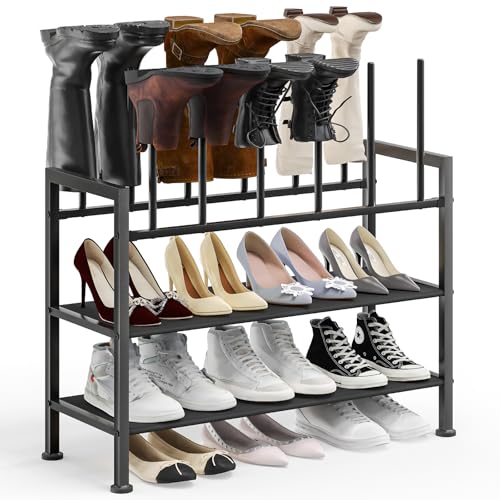
DIMJ 4-Tier Boot Rack Black Metal

Amoowis Metal Boot Rack 8-Pair

Amoowis Metal Boot Rack 12-Pair
Inside Each Recommended Option
For a narrow closet or an apartment entryway, the SNTD Expandable Metal Shoe Rack slides into spaces most racks can’t. The frame telescopes from roughly 18 inches out to 30 inches, which means it can live behind a door one season and stretch under a window the next. Adjustable shelf height also lets you open up one tier for taller pairs, a small touch that matters when you’re trying to keep a single pair of cowboy boots upright.
I think of this one as the “starter” option, useful when a household owns a few pairs of boots alongside sneakers and loafers. Metal tubing keeps it light, the black finish blends with most trim, and the whole thing moves without a fight. It’s a step up from tossing boots by the door, without overcommitting to a giant tower.
Key Advantages
- Telescoping frame adapts to narrow closets and wider entryways
- Adjustable tier height creates room for taller boots
- Stackable design for households that want to grow their storage later
- Lightweight metal body is easy to reposition
Worth Noting
- Two tiers limit total pair count to roughly eight, so large collections will overflow quickly
- No dedicated inverted rods, meaning cowboy boots may crease at the shaft if left folded over the bar
Feature Snapshot
Best Suited To
Renters and apartment dwellers with a handful of cowboy boots who want something that won’t dominate the entryway.
Look Elsewhere When
The Heritage Forge Rustic Horseshoe Boot Rack is a better fit for someone decorating a bunkhouse or mudroom where rustic style matters as much as storage.
The Heritage Forge Rustic Horseshoe Boot Rack leans hard into western style. Each one is built from new, genuine horseshoes, so every rack carries the slightly uneven weight of hand-bent steel. You can add a custom name or short phrase across the top, which makes this feel less like a closet accessory and more like a piece of wall art for a mudroom.
Sizing depends on how many pairs you need to hold: a 1-pair rack runs about 12 inches wide, a 2-pair 22 inches, a 3-pair around 32.5 inches, and a 4-pair version stretches further. That width range lets the rack scale with a household, from a small apartment landing strip to a full ranch entry. Compared to the SNTD rack that opened this list, this one prioritizes character over capacity.
What Works In Its Favor
- Hand-built horseshoe construction adds genuine western character
- Custom name personalization makes it a strong gift item
- Lifts boots off the floor to block dust and critters
- Width options scale from single-pair to four-pair households
Trade Offs
- No enclosed sides, so boots can collect dust on top of the shafts over time
- Heavier steel means wall-mounting or floor placement both need solid anchoring
Whose Shelf It Belongs On
Ranch owners, weekend rodeo volunteers, or anyone outfitting a bunkhouse-style mudroom with personality baked in.
Reach For A Different Pick When
The SNTD Expandable Metal Shoe Rack suits renters better, since its adjustable width slides into closets without drilling.
When one closet has to handle work boots, cowboy boots, school sneakers, and Sunday church shoes, the EnHomee 6-Tier Shoe Rack earns its keep. The frame measures roughly 39 inches wide, 12 inches deep, and 41 inches tall, so it parks along a hallway wall without eating the room. A dedicated tall boot section sets it apart from generic towers, giving shafted pairs their own upright slot rather than a folded-over mess.
Capacity reaches about 24 pairs when shelves are stacked with shorter shoes, which most families will hit before they outgrow. Each mesh shelf carries up to 33 pounds, the top surface 55 pounds, and the side hanging pockets another 22 pounds. Four leveling feet keep the unit steady on uneven floors. This is the rack for a busy entryway, not a spare closet.
The Practical Payoff
- Six tiers plus a tall boot section handle mixed footwear in one frame
- Mesh shelves and side pockets add storage beyond the boot rows
- Reinforced frame supports heavy leather pairs without bowing
- Adjustable leveling feet protect floors and stop wobble
Points To Note
- Larger footprint requires a dedicated wall section to look tidy
- Mesh shelves can collect dust between boots in dry climates
Feature Snapshot
Who It Suits Best
Busy families running multiple pairs of boots and sneakers through a single entryway each morning.
Skip It When
The DIMJ Boot Rack 3-Tier is a smarter pick for someone storing only tall leather boots who wants inverted rod support.
The DIMJ Boot Rack 3-Tier solves a problem most generic racks ignore: keeping tall leather boots upright without creasing the shaft. Boots hang upside-down on long rods, which lets gravity do the work of straightening the leather instead of fighting it. A 3-tier build holds up to 10 pairs, so a household with a deep cowboy boot rotation can rotate through seasons without cramming.
The metal frame is sturdy enough to handle wet or muddy pairs pulled straight from a barn aisle. Owners commonly leave it near a back door because cleanup is simple and ventilation stays high, which keeps odors down. Against the EnHomee rack above, this one trades mixed footwear variety for dedicated boot support.
Standout Benefits
- Inverted rod design prevents the creases that flat shelves cause
- Long rods keep tall shafts straight over months of storage
- Open metal frame promotes airflow, reducing moisture and odor
- Sturdy construction handles boots fresh from rain or mud
Honest Caveats
- Hanging boots upside-down shifts the toe upward, which can stretch the heel counter on very soft leather over time
- Sneakers and low shoes don’t sit naturally on the rod layout
Built With In Mind
Cowboy boot collectors who own several pairs of tall leather and want shape retention over long storage.
Consider Something Else When
The Amoowis Metal Boot Rack 12-Pair is a smarter fit for households mixing short and tall boots, since its adjustable height adapts to both.
The DIMJ 4-Tier Boot Rack stretches the upside-down boot concept across more boots. Holding roughly 6 pairs of tall boots, plus space for shorter styles, it balances a closet between cowboy boots and the sneakers that fill the gaps between them. The 4-tier build gives each pair a dedicated rod, which means nothing ends up leaning against a wall at 2 a.m.
Build quality matches the brand’s other racks, with a metal frame that tolerates daily entryway abuse. Compared to the 3-tier above, this one trades a smaller footprint for extra vertical storage, a sensible swap for households climbing toward a dozen pairs. Airflow stays strong, so a damp pair drying after a wet trail won’t sour the whole closet.
Good Reasons To Consider
- Upside-down rods prevent shaft creasing on tall boots
- 4 tiers add capacity without taking up much more floor space
- Open frame design supports ventilation between pairs
- Fits tall knee-high, riding, hiking, rain, and work boots
Possible Compromises
- Holds only about 6 boot pairs, so the deepest collectors will need a second rack
- Taller build needs a wall corner to stay out of the walkway
Quick Facts
Right Fit For
Closet organizers managing a mix of tall boots and sneakers who want one rack that handles both.
A Better Fit Elsewhere
The Heritage Forge Rustic Horseshoe Boot Rack serves a household that wants rustic western character alongside storage.
The Amoowis Metal Boot Rack handles about 8 pairs in a frame designed to cradle boots at the calf rather than hang them from the toe. That upside-down hanging design, paired with a top tray for keys and hats, turns a closet corner into a complete boot station. Mid-calf, knee-high, cowboy, work, and riding boots all fit the layout, which is unusual for a rack in this footprint.
I think of this as a step up from the entry-level racks without committing to the largest tower on the list. The metal frame stays stable under heavy leather, and the dedicated cradles keep shafts straight through long storage. Owners in dry climates will appreciate the dust-blocking layout, though wet boots need drying time before they go up.
Positive Points
- Engineered cradles prevent creases, sagging, and misshaping
- 8-pair capacity covers most working households
- Top tray adds a drop zone for daily gear
- Wide compatibility across cowboy, work, and riding boots
Things To Weigh
- Cradle design works best with dry boots, so a damp pair from the barn needs drying first
- No dedicated rod ventilation for very tall shafts past knee height
Feature Snapshot
Who Will Love This
Working ranch hands and weekend riders who want a single rack for both daily boots and special-occasion pairs.
Swap It Out When
The Amoowis Metal Boot Rack 12-Pair is a better fit for households needing adjustable height to handle extra-tall shafts.
The Amoowis Metal Boot Rack 12-Pair is the tallest build on this list, which is exactly why it earned its spot. The frame includes adjustable height across four levels, so a pair of extra-long winter or riding boots has somewhere to live without folding or hanging off the end. The upside-down hanging design keeps each boot upright, preventing the creases and sagging that ruin leather over a season of bad storage.
For collectors running 10 or more pairs, this rack absorbs the whole closet in one footprint. A specially engineered top tray finishes the layout, useful for storing polish, socks, or a hat. Against the 8-pair version above, this one buys taller clearance and extra capacity at the cost of a larger footprint. In most hallways it lives best against a wall corner.
A Few Highlights
- Adjustable height across four levels fits extra-long shafts
- 12-pair capacity handles deep boot collections
- Upside-down cradles block dust and prevent creasing
- Top tray adds useful storage for boot-care gear
A Few Limitations
- Taller build demands more vertical clearance than a low closet offers
- Larger footprint requires planning the layout to avoid crowding a doorway
Spec Overview
Perfect Match For
Collectors running tall cowboy and riding boots who want one rack that grows with the closet.
Not Your Match When
The EnHomee 6-Tier Shoe Rack suits families needing a wide tower for mixed footwear rather than dedicated boot height.
Choosing a Cowboy Boot Rack That Earns Its Spot
A cowboy boot rack earns its place by doing three things at once: keeping leather upright, letting air move around the shafts, and surviving the daily grind of a busy entryway. The wrong rack, by contrast, lets boots fold over flat shelves, traps moisture against the leather, and starts wobbling within a season. Knowing how each rack earns or loses those three jobs is the heart of choosing well.
Build Material and Frame Strength
Metal frames outlast particleboard in boot rooms, especially when boots come in damp from a trail or barn. Welded steel tolerates the weight of full leather without bowing, and coated finishes resist rust in humid closets. For most households, a metal frame is the safer long-term bet, particularly when a rack holds 8 or more pairs.
Storage Style and Boot Shape
Inverted rod designs cradle boots from the shaft, keeping leather straight and crease-free over months of storage. Flat shelves force boots to fold at the ankle, which is where most creases start. Cowboy boots with 10- to 14-inch shafts benefit most from inverted rod systems, while shorter boots handle flat shelves reasonably well.
Capacity and Footprint
Capacity numbers tell only half the story. A 12-pair rack in a tight hallway can dominate a room, while a 6-pair rack in the same hallway disappears. Measure the floor space first, then match capacity to what fits without crowding. In small spaces, taller narrow racks tend to work better than wide towers.
Climate, Cleaning, and Airflow
Open metal frames promote airflow, which matters in humid climates where leather can mildew in a closed rack. Dust-blocking cradles suit dry, dusty regions, while ventilated rods suit wetter environments. Cleaning is straightforward either way, since metal wipes down with a damp cloth and boots stay accessible without unstacking.
Key Considerations Across These Picks
Pitfalls Shoppers Hit
The most common mistake is buying a flat-shelf rack and assuming boots will simply stand up. They won’t. A second slip is underestimating pair count, since most owners collect more boots over time than they expect. Finally, ignoring closet dimensions forces awkward placements where boots crowd a doorway or block a vent.
Where The Extra Money Goes
Higher-tier racks earn their cost through stronger steel, better welds, and inverted rod systems that protect leather over years. A premium rack also tends to include adjustable height, which extends usefulness across boot styles. For households with serious boot collections, the upgrade pays off through longer leather life and fewer creased pairs in rotation.
Frequently Asked Questions
Do cowboy boots need a special rack?
Yes. Cowboy boots have tall shafts that fold and crease on flat shelves. A rack with inverted rods or upright supports keeps the leather straight and the toe box in shape.
How many pairs should a boot rack hold?
Most households with 2 to 4 boot owners land between 8 and 12 pairs. Larger collections benefit from wider towers, while small closets do fine with a 4- to 8-pair rack.
Can I store wet boots on a metal rack?
Metal handles moisture better than wood, but boots should air-dry briefly before storage. Long-term dampness can still cause leather odor, even on ventilated racks.
Will inverted rods stretch boot shafts?
In most cases, no. Inverted rod designs support the shaft without pulling on the leather. Very soft or worn boots may need shorter storage periods.
Where should a cowboy boot rack live?
A cool, dry closet corner is ideal. Avoid placing racks directly against heating vents or in damp basements, since both extremes shorten leather life.
Bottom Line
The right cowboy boot rack depends on closet size, collection depth, and how much style matters alongside storage. For a small apartment, the SNTD expandable rack slides in quietly. For a ranch mudroom, the Heritage Forge horseshoe rack carries western character. For collectors running 10 or more pairs, the Amoowis 12-Pair rack earns the spot through adjustable height and dedicated cradles. Pick the rack that matches the collection you actually own, not the one you wish you had.