Shopping for affordable running shoes gets messy fast. Marketing buzzwords stack up, every brand claims “cushioned” or “supportive,” and the difference between an $80 pair and a $130 pair isn’t always obvious. I built this shortlist to make the decision simpler: eight budget-friendly women’s running shoes that handle daily miles without forcing you into a high-end tier.
How The Shortlist Stacks Up


Puma Womens Softride Mayve
ASICS Women’s GT-1000 13

adidas Women’s Response Pace

Adidas Womens Pureboost 22


The Strengths Of Each Pick
The Gel-Excite 10 sits in that sweet spot where ASICS packs real running DNA into an entry-level silhouette. The jacquard mesh upper breathes well on summer pavement runs, and the AMPLIFOAM PLUS midsole (a layered EVA foam, meaning the kind of soft, flexible cushioning most daily trainers use) keeps things cushioned without feeling mushy under the heel. Compared to the heavier JOLT 5 reviewed later, this one feels noticeably softer through the midfoot.
Beginners easing into a 5K routine get a shoe that doesn’t punish the gait work, and the GUIDANCE LINE groove underfoot helps each footfall track straight. The OrthoLite sockliner (a removable foam insert that adds step-in comfort and can be swapped for custom orthotics) pulls out for cleaning, which matters after sweaty long runs.
Advantages To Know
- AMPLIFOAM PLUS midsole softens repetitive impact on concrete
- Jacquard mesh upper improves airflow during warm-weather miles
- GUIDANCE LINE flex groove supports a more consistent stride pattern
- Removable OrthoLite sockliner makes custom insole swaps easy
- Light enough for tempo work but stable enough for recovery days
Worth Noting
- Stack height (the total thickness of material between foot and ground) feels modest to runners used to max-cushion trainers
- The plush upper may feel warm on humid summer runs above 85°F
Made For
New runners building a habit, or anyone logging three to five easy miles per day who wants reliable cushioning without a premium price.
Swap It Out When
Runners with heavier overpronation patterns may prefer the structured ASICS Women’s GT-1000 13, which adds a more pronounced stability system.
Puma’s Softride Mayve leans lifestyle more than performance, but that’s exactly why it earns a spot on a budget shortlist. The knit upper stretches over the forefoot nicely, and the SOFTRIDE foam (Puma’s plush, low-density EVA blend engineered for soft landings) lives up to its name. This feels less like a serious training shoe and more like the comfiest option in the lineup for errands, walking meetings, or a casual loop around the block.
Where the ASICS Gel-Excite 10 above prioritizes run-ready structure, this one trades support for plush comfort. The Softfoam+ footbed cushions every step, and the clamshell construction (where the upper wraps cleanly around the midsole in one piece) gives a sleek, sock-like fit.
Points In Its Favor
- SOFTRIDE foam gives a pillowy, low-impact feel underfoot
- Knit upper adapts to wider feet without pressure points
- Versatile look pairs with leggings or weekend jeans
Points To Keep In Mind
- Lighter midsole structure isn’t built for high-mileage training weeks
- Heel lockdown runs slightly loose for runners with narrow heels
Key Specs
Right Fit For
Commuters and walkers who want one shoe for the gym locker, the sidewalk, and the coffee run without changing pairs.
Another Choice May Suit
Runners stacking real mileage every week get more from the ASICS Women’s JOLT 5, which has a firmer EVA midsole (a traditional foam cushioning that’s denser and more responsive than SOFTRIDE) built for repeated footstrikes.
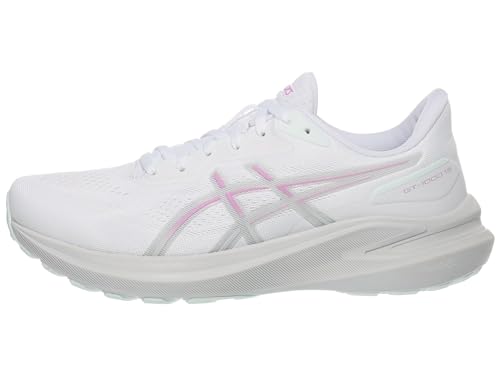
The GT-1000 13 is the structured sibling of the Gel-Excite 10 reviewed first. ASICS built this one around a 3D GUIDANCE SYSTEM (a layered midsole geometry that helps the foot roll forward smoothly rather than collapsing inward), which makes it the budget pick for runners who pronate, or roll their foot inward when landing. The FLYTEFOAM midsole (a lightweight, bouncy foam blend) keeps the shoe from feeling heavy despite all that structure.
For someone who logs four or five runs a week and notices knee or arch fatigue, the stability features here earn their weight. The mesh and synthetic upper breathes decently for an ASICS stability shoe, though it runs a touch warmer than the Gel-Excite’s jacquard weave.
Where It Delivers
- 3D GUIDANCE SYSTEM adds structure for runners who overpronate
- FLYTEFOAM midsole is lighter than the older GT-1000 versions
- Softer landings reduce fatigue on longer training blocks
Honest Caveats
- Heavier than neutral trainers like the Gel-Excite 10
- Stability features feel unnecessary for runners with neutral mechanics
Feature Snapshot
Who It Suits Best
Runners with overpronation patterns or anyone who feels ankle fatigue after longer runs and needs extra guidance through the gait cycle.
A Better Fit Elsewhere
Neutral runners with no stability concerns will find the ASICS Women’s Gel-Excite 10 lighter and more flexible for daily miles.
The JOLT 5 is what I reach for when someone asks the honest question: “What’s the cheapest running shoe that won’t fall apart on me?” The solid rubber outsole (a dense, durable rubber compound that resists wear longer than lightweight blown rubber) handles sidewalk miles, and the EVA midsole keeps the price honest without skimping on basic impact protection. It’s not glamorous, and it doesn’t try to be.
The roomier forefoot suits runners with wider feet, and the extra flex grooves (cutouts in the outsole rubber that let the shoe bend more naturally with the foot) make the transition from heel to toe feel less clunky than older JOLT models. Compared to the Gel-Excite 10 above, this one skips the AMPLIFOAM PLUS softness for a firmer, more grounded feel.
The Helpful Details
- EVA midsole delivers firm, durable cushioning at a low cost
- Solid rubber outsole extends shoe life on rough pavement
- Plush OrthoLite sockliner cushions every step
- Roomier forefoot accommodates wider foot shapes
Things To Consider
- Less cushioning depth than the Gel-Excite 10 for long runs
- Styling reads more “gym class” than “lifestyle crossover”
Best Suited To
Beginners on a tight budget who want a no-nonsense daily trainer that holds up through a few months of regular use.
Skip It When
Runners who prefer a softer, more cushioned ride should consider the adidas Women’s Response Pace, which uses Cloudfoam (a plush, pillowy EVA formulation from adidas) for a plusher step-in feel.
The Response Pace lands in the budget tier with one feature most cheap trainers skip: a real Cloudfoam midsole (adidas’s signature cushioning foam, designed to feel pillow-like under the foot). The breathable mesh upper keeps feet cool through three-mile loops, and the traditional lace system lets you dial in midfoot hold the way you want it.
This shoe feels more like an everyday trainer than a performance racer. Runners who treat running as part of a broader fitness routine (lifting, walking, occasional jog) get the most value here. The ASICS JOLT 5 reviewed above feels firmer underfoot, so this one wins for anyone who wants plush comfort at the lowest cost.
The Case For It
- Cloudfoam midsole offers pillowy comfort at a budget-friendly cost
- Breathable mesh upper prevents heat buildup on longer walks
- Neutral look transitions from treadmill to errands easily
Practical Considerations
- Outsole rubber tends to wear faster than premium trainers on rough asphalt
- Less arch structure than the ASICS GT-1000 13 for pronators
Who Should Grab It
Entry-level runners who want plush cushioning for short-to-mid distance runs and don’t need stability features.
Look Elsewhere When
Runners who need firmer, more responsive energy return for tempo days should look at the Adidas Womens Pureboost 22, which uses full-length BOOST foam for livelier strides.
The Pureboost 22 is the most energetic shoe on this list. The full-length BOOST midsole (adidas’s flagship cushioning material, made of expanded TPU pellets that store and release energy with each step) gives a springy, propulsive feel that’s rare in budget trainers. The mesh upper lets air move freely, and the high-traction rubber outsole grips wet sidewalks better than the average budget trainer.
Where the adidas Response Pace above feels cushioned and soft, this one feels bouncy. For runners who want some pep in their daily miles without stepping into a $180 flagship, the Pureboost 22 sits in a useful middle ground.
Real-World Strengths
- BOOST midsole delivers genuine energy return in the budget tier
- Mesh upper breathes well on hot pavement days
- High-traction outsole handles wet conditions confidently
- Feels lighter than most max-cushion trainers
Where It May Fall Short
- BOOST foam feels firmer than Cloudfoam in cold weather
- Less stable for runners needing extra arch support
Perfect Match For
Runners who want a responsive, lively ride for daily training miles and don’t need a stability shoe.
Reach For A Different Pick When
Runners who overpronate will find the ASICS Women’s GT-1000 13 offers better structural support for the gait cycle.
Reebok’s Zignition is the lightest shoe on this shortlist, and that single trait defines the experience. The engineered mesh upper (a knit-style fabric with strategic ventilation zones) disappears on the foot, and the dynamic lacing system pulls the midfoot in evenly without hotspots. It runs more like a stripped-down trainer than a cushioned cruiser.
For runners who value speed and breathability over plushness, this is a sensible budget pick. Compared to the ASICS Gel-Excite 10 reviewed earlier, the Zignition feels noticeably more minimal underfoot.
A Few Strong Suits
- Engineered mesh upper offers excellent airflow for warm-weather runs
- Lightweight build reduces leg fatigue during short tempo efforts
- Plush cushioned collar prevents ankle irritation on longer routes
Potential Drawbacks
- Less cushioning depth than the Gel-Excite 10 for longer distances
- Minimal structure may not suit runners needing extra arch support
Built With In Mind
Runners who want a fast, airy trainer for short-to-mid distance efforts and don’t need a thick cushioned ride.
A Sibling Pick Shines
Runners who prefer more plush comfort should consider the Reebok Energen Run 4, which adds more cushioning depth for the same everyday mileage.
The Energen Run 4 closes out the list as the most affordable option that still feels like a real running shoe. The engineered mesh upper is one of the most breathable in the lineup, and Reebok built this one for multi-purpose use: treadmill runs, gym sessions, walks, recovery days. It handles all of them adequately without excelling in any single area.
For shoppers watching every dollar, this is the honest entry point. The Reebok Zignition reviewed above feels lighter and faster; the Energen Run 4 trades that quickness for more versatile daily wear.
Strong Points
- Ultra-breathable mesh upper handles sweaty workouts well
- Multi-purpose build works for gym, run, and walk sessions
- Light enough for casual jogging without bulk
Small Caveats
- Cushioning feels thin compared to the Reebok Zignition for long runs
- Basic styling reads as more “starter” than “lifestyle crossover”
Quick Facts
Whose Shelf It Belongs On
Budget-focused shoppers who want one affordable pair that handles treadmill runs, gym sessions, and casual walks without specialized features.
Where Another Pick Suits Better
Runners who want a more responsive, energetic ride for daily miles should consider the Adidas Womens Pureboost 22, which uses BOOST foam for livelier strides.
What To Weigh Before Choosing Budget Womens Running Shoes
Fit beats features every time. A cheap shoe that fits your foot shape will outrun a pricey one that doesn’t, so prioritize trying on width, toe box room, and heel lockdown before chasing tech specs. Most budget running shoes use standard D-width (a regular foot width fitting, where B is narrow and 2E or 4E are wider), but brands like ASICS and Puma run slightly narrower than Reebok and adidas.
Cushioning type matters more than advertised thickness. EVA midsoles (the dense foam used in most trainers, including the ASICS JOLT 5) feel firm and durable, while Cloudfoam and SOFTRIDE foams lean softer and more pillowy. BOOST and AMPLIFOAM blends add bounce for runners who want energy return. Pick the feel you prefer, not the foam name that sounds premium.
Stability features matter for some feet, not for others. Runners who overpronate (whose ankles roll inward when landing) benefit from structured midsoles like the 3D GUIDANCE SYSTEM in the GT-1000 13. Neutral runners can skip those features and save weight. If you’re unsure about your gait, most running stores offer free video gait analysis.
Outsole rubber is the durability signal. Solid rubber outsoles (dense, abrasion-resistant rubber compounds) like the one on the JOLT 5 last longer on rough pavement than blown rubber (a lighter, more cushioned but faster-wearing rubber type). Heavier runners generally want denser outsoles because lighter compounds wear through faster.
Key Considerations Across These Picks
Pitfalls Shoppers Hit
The most common mistake I see is picking shoes based on cushioning thickness alone. A 40mm stack height (the total height of midsole material between foot and ground) sounds impressive, but if the foam feels wrong under your foot, the shoe will collect dust. Try to test ride shoes in socks on a hard surface before committing.
Another trap is buying a shoe one size up to “allow room.” Running shoes should fit snugly in the heel and midfoot with about a thumb’s width of room in the toe box. Sizing up ruins lockdown and causes blisters within a few miles.
Where The Extra Money Goes
Stepping up from the sub-$80 tier (JOLT 5, Response Pace, Energen Run 4) to the $100+ tier (Gel-Excite 10, Pureboost 22, GT-1000 13) typically buys better foam technology and more refined upper construction. The mid-tier shoes tend to use branded foams like AMPLIFOAM, BOOST, or FLYTEFOAM, which feel more energetic and last longer than basic EVA.
Premium-priced budget shoes (like the GT-1000 13) also tend to add stability features, more thoughtful geometry, and better-quality outsoles. Runners logging 20+ miles per week benefit most from that jump; casual joggers may not notice the difference.
Frequently Asked Questions
How long should budget running shoes last?
Most budget trainers last 300 to 500 miles before the midsole foam breaks down. Heavier runners or those running on rough pavement may see the lower end of that range.
Do I need to break in budget running shoes?
Light wear helps the upper mold to your foot, but you should never run through pain. A properly fitting shoe feels comfortable from the first mile.
Should I match shoes to my gait type?
Runners with overpronation benefit from stability shoes like the GT-1000 13. Neutral runners typically do fine in softer trainers like the Gel-Excite 10 or Pureboost 22.
Can I use budget running shoes for the gym?
Most budget running shoes work fine for treadmill runs, walking, and light gym sessions. The Energen Run 4 and Response Pace are particularly versatile for mixed workouts.
How do I clean budget running shoes?
Remove the insoles, hand-wash with mild soap and cold water, and air-dry away from direct heat. Machine washing damages foam midsoles and glued seams over time.
Closing Thoughts
A solid pair of budget women’s running shoes doesn’t have to feel like a compromise anymore. The eight options here cover most runner profiles: cushioned cruisers for daily miles, structured trainers for overpronators, energetic options for tempo days, and versatile picks for mixed workouts. Match the shoe to your gait and mileage, not the marketing copy, and you’ll likely find a pair that holds up well past the first hundred miles.