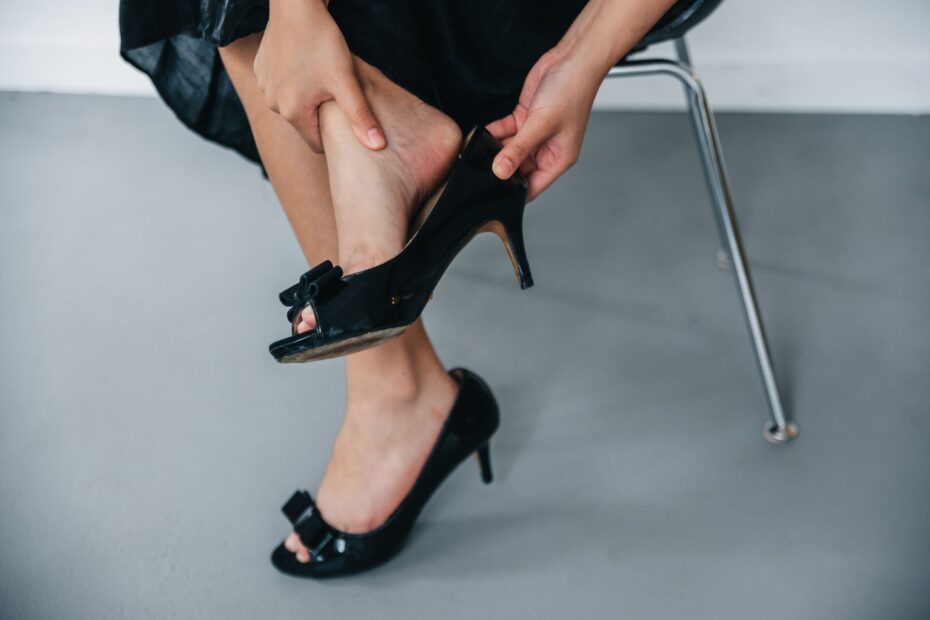
A forward weight shift, crowded toes, and a downward-pointed ankle can leave feet sore or sharply painful after a night in heels. After several hours on hard floors, pressure can build beneath the metatarsal bones while your calf muscles and Achilles tendon stay in a shortened position.
The sections below separate short-lived soreness from symptoms that merit clinical attention, then give you practical recovery and footwear choices for work, ceremonies, and long evenings.
Heels Shift Body Weight Toward the Forefoot
With each inch of lift, more body weight moves to the ball of the foot instead of spreading across the heel, arch, and forefoot. The metatarsal heads, which are the rounded ends of the long foot bones, take a concentrated load with every step.
Your foot also loses part of its normal shock absorption. In a flat shoe, your heel reaches the ground and your ankle moves through a fuller range. In high-heeled shoes, the ankle stays pointed downward, so your steps can feel sharper during a long standing shift or a walk across a large event space.
Forefoot Pressure Can Lead to Metatarsalgia
Pressure beneath the forefoot rises as heel height rises. The padded tissue beneath your metatarsal bones gets compressed, which can lead to metatarsalgia, a term for aching, burning, or sharp pain under the ball of the foot.
For example, a three-inch pump worn during a three-hour reception keeps your body in a forward-leaning position even while you stand still. Your toes and forefoot become a small platform carrying more of your body weight, and fatigue can build fast.
Altered Gait Can Strain the Legs and Back
Balance changes because your ankle remains pointed downward. Your calf muscles stay shortened, your knees absorb motion differently, and your hips shift to keep you upright. That altered gait can add strain to your ankles, knees, hips, and lower back.
The pressure does not stop at the sole of your foot. Guidance from the American Podiatric Medical Association links high heels with excess forefoot stress and changes in body alignment.
Shoe Design Directs Pressure to Different Tissues
Heel height explains part of the strain, but shoe shape decides where the force lands. A lower block heel with a roomy front can feel far less harsh than a slightly taller shoe with a pointed toe, rigid upper, and thin sole.
A Wider Heel Base Gives the Ankle More Stability
A thin stiletto narrows your contact point with the ground. That smaller base makes ankle instability more likely on uneven sidewalks, stairs, or slick floors and raises the chance of an ankle sprain or fall.
Platforms lower the effective slope under your forefoot because the front of the shoe rises too. But a platform does not solve a loose heel counter, a narrow toe box, or a shoe that makes your toes grip for balance.
| Shoe feature | Effect on your foot | Lower-strain direction |
|---|---|---|
| Tall, narrow heel | Pushes weight forward and makes ankle balance less steady | Lower heel with a wider base |
| Pointed toe box | Compresses toes and small nerves | Toe room that lets your toes rest straight |
| Rigid forefoot sole | Creates pressure hot spots beneath metatarsal heads | Forefoot cushioning with some flex |
| Loose heel area | Makes your toes grip to hold the shoe in place | Secure strap or firm heel counter |
Toe-Box Compression Can Irritate Skin and Nerves
A narrow toe box squeezes toes together and presses on nerves between the metatarsal bones. High heels causing toe pain and numbness can also leave you with corns, calluses, or blisters where skin rubs against seams and stiff edges.
- Toe pinching suggests that the front of the shoe is too narrow for your foot shape.
- Heel slipping makes your toes curl and grip during each step.
- Rigid material raises rubbing before the upper softens around your foot.
- Thin insoles leave little padding between your forefoot and hard flooring.
- Long wear time turns a tolerable fit into worsening pressure and swelling.
Feet can swell through the day, especially after standing. A pair that feels fine at 8 a.m. can become restrictive by late afternoon, so your symptoms may peak near the end of an event.
As pressure accumulates, the exact spot that hurts can help identify which tissue is being overloaded.
Pain Location Can Point to the Stressed Structure
The exact location matters because pressure injury, nerve irritation, tendon tightness, and bone stress do not feel alike. Your symptoms cannot diagnose a condition on their own, but the pattern can show whether rest is reasonable or medical care belongs next.
| Where and how it hurts | Heel-related clue | Practical next step |
|---|---|---|
| Ball of foot aches, burns, or stabs during push-off | Forefoot overload or metatarsalgia | Stop heel wear and take pressure off the area |
| Burning or numbness between toes | Toe-box compression or Morton’s neuroma | Seek clinical assessment for recurring symptoms |
| Heel or arch pain with initial steps after rest | Plantar-fascia-related irritation | Wear cushioned flat shoes and use gentle mobility |
| Calf or Achilles soreness after shoe removal | Calf muscle shortening and Achilles tendon tightness | Move through a slow, comfortable range |
| Pinpoint bone pain, bruising, or one-sided swelling | Possible injury, including stress fracture | Seek prompt medical advice |
Ball-of-Foot and Toe Symptoms Have Different Patterns
High heel pain in the ball of the foot tends to worsen during standing and the push-off phase of walking. That pattern fits overloaded metatarsal heads, especially after hours in a steep shoe with minimal cushioning.
Burning, tingling, or numbness between the third and fourth toes points more toward nerve irritation. Morton’s neuroma involves thickened or irritated tissue around a nerve, and repeated toe-box compression can aggravate it. Recurring nerve symptoms deserve more than repeated shoe adjustments.
Heel, Arch, Calf, and Achilles Pain Have Separate Causes
Heels can aggravate plantar-fascia-related heel or arch pain, though they do not prove that they caused it. Pain with your initial steps after sitting or sleeping fits that pattern more closely than pain limited to the ball of your foot.
Calf soreness after shoe removal comes from prolonged shortening in the raised-heel position. Existing bunion irritation, hammertoes, arthritis, or a bunion called hallux valgus can lower your tolerance because the shoe presses on structures that are already sensitive.
When a sensitive structure has been compressed, protecting it early can keep a temporary flare from worsening.
New numbness, spreading tingling, bruising, or sharply localized bone pain deserves prompt attention rather than another attempt to make the same shoes work.
Recovery During the Next 48 Hours Starts With Removing Pressure
Pressure needs to come off before sore tissue can settle. Switch out of heels that evening, wear a roomy flat shoe with cushioning, and skip running, jumping, or long walks until your normal step returns.
- That evening remove the pressure source, rest your foot, and place a cold pack wrapped in cloth on sore areas for short intervals.
- Check the skin cover intact rubbing areas with blister protection, but do not pop or cut a blister.
- Use gentle motion move your ankle and toes through a comfortable range without forcing a painful stretch.
- Choose flat footwear wear a shoe with toe room and cushioning during the next day or two.
- Resume walking gradually return to normal activity as soreness fades and your gait stops favoring one side.
Metatarsal Pads, Ice, and Medicine Have Limits
Metatarsal pads can spread load across the forefoot, but placement matters. Set the pad just behind the painful metatarsal area, not directly beneath it, or you can intensify pressure. A podiatrist can show you pad placement or discuss custom orthotics for recurring mechanical pain.
Over-the-counter pain medicine can ease short-lived soreness for adults who can take it safely, yet it should not mask pain that grows during activity. Your pharmacist or clinician can answer medication questions involving stomach ulcers, kidney disease, blood thinners, pregnancy, or other medicines.
Foot pain after wearing high heels is moving in the right direction as soreness declines, walking looks normal, and numbness does not spread. Pain that intensifies across 48 hours needs a different response than ordinary post-event fatigue.
Lower-Strain Heel Choices Can Limit Repeat Flares
A shoe does not need to be flat to lower some strain, but it must stop fighting your foot. Lower heels, a broad base, secure straps, a firm heel counter, and forefoot cushioning spread force more evenly than a narrow, slippery pump.
Fit Shoes After Your Feet Have Expanded
By late afternoon, normal activity can make feet swell, so shopping then helps you judge shoe fit more accurately. Stand in both shoes, walk on a firm surface, and check that your toes stay relaxed rather than curled under or pressed against the front.
Leave behind a pair that causes pinching, heel slippage, numbness, or a need to grip with your toes in the fitting area. A narrow shape rarely widens enough through wear to match a wider forefoot.
Shorter Wear Time Limits Forefoot Loading
- Commute in flats reserve heels for the part of your day that truly calls for them.
- Build time slowly wear a new pair briefly at home before a long event.
- Take seated breaks take repeated load off your forefoot during receptions, meetings, or ceremonies.
- Bring another pair change shoes at the first sign of burning or numbness.
- Respect recurrence stop heel wear during a flare of bunion, arch, or nerve pain.
Inserts from brands such as Dr. Scholl’s or Superfeet can add cushioning or arch support, but an insert cannot correct a shoe that crushes your toes or wobbles under your ankle. Your most useful change is shorter wear time paired with a shape that matches your foot.
Persistent or Severe Symptoms Need Medical Care
Brief soreness that eases after rest differs from pain that keeps changing how you walk. Symptoms lasting more than a few days, returning after every heel-wearing occasion, or interfering with daily activity warrant an appointment with a podiatrist or another qualified clinician.
Sudden Injury Signs Go Beyond Ordinary Soreness
- Weight-bearing failure needs prompt care, especially after a twist, misstep, or fall.
- Marked swelling on one side can signal a sprain, joint injury, or bone problem.
- New bruising near a painful area raises concern for injury beyond pressure irritation.
- Pinpoint bone tenderness can occur with a stress fracture and should not be ignored.
- Visible deformity needs urgent assessment after a fall or sudden severe pain.
Persistent burning, weakness, numbness, redness, or warmth also needs prompt medical advice. Diabetes, poor circulation, and reduced sensation raise the stakes because skin injury and infection can become harder for your body to detect.
A stress fracture is a small bone crack linked to repetitive loading. That description matches information from the American Academy of Orthopaedic Surgeons. Stop wearing the shoes linked with the pain, track where it hurts and what triggers it, then bring those details to your appointment.
Final Thoughts on Heel-Related Foot Pain
Your shoes are more than an accessory beneath a sore foot. Heel height, toe shape, stability, cushioning, and wear time direct force into different tissues. Choose a lower, steadier design where possible, stop before discomfort becomes numbness or altered walking, and seek care for pain that persists, repeats, swells, or feels sharply focused over bone.
FAQ
Why do my feet hurt after wearing high heels?
Your weight shifts toward the forefoot, while a narrow toe box can compress toes and nerves. Your ankle also stays pointed downward, which shortens your calf muscles and Achilles tendon during wear.
What parts of the foot are most affected by high heels?
The ball of your foot, metatarsal bones, toes, calf muscles, and Achilles tendon take much of the strain. Your ankle can also become less stable in a tall, narrow heel.
Can wearing high heels cause plantar fasciitis, bunions, or Morton’s neuroma?
Repeated forefoot pressure and altered mechanics can aggravate plantar fasciitis, bunions, or Morton’s neuroma. Repeated pressure can also worsen bunion pain and irritate tissue around the nerve involved in Morton’s neuroma.
Why does the ball of my foot hurt after heels?
The ball of your foot carries extra pressure in a raised-heel position. Soreness, burning, or stabbing pain during push-off can fit metatarsalgia or another form of forefoot overload.
How long should foot pain last after wearing high heels?
Short-lived soreness should ease across a day or two after rest, roomy flat shoes, and a break from impact activity. Pain lasting beyond several days, returning with each heel-wearing occasion, or changing your walking pattern needs medical attention.
What can I do to relieve foot pain after a night in heels?
For how to relieve foot pain from high heels, remove the shoes, rest your foot, wear cushioned flats, and place a cloth-wrapped cold pack on sore areas for short intervals. Gentle ankle and calf motion can ease stiffness without forcing painful stretches.