A patch of black ice under a hiking boot, a snowy porch step at 7 a.m., a dog walk on a frozen trail, those small moments are exactly where traction matters. I’ve spent enough winters choosing the wrong overshoe and watching my feet slide to know that the right ice-and-snow grip changes how you move through the cold months. This list rounds up six traction options built for different feet, different surfaces, and different kinds of winter days, so you can pick what actually fits your routine.
An Overview Of The Picks

Kahtoola MICROspikes Footwear Traction for Winter Trail Hiking

Giggleway Kids Crampons for Hiking Boots and Shoes

Winter Walking Spare Spike Industrial Traction Aid

AGOOL Ice Cleats Snow Walk Traction Crampon 28 Studs

AGOOL Ice Cleats Snow Traction Slip-on Crampons
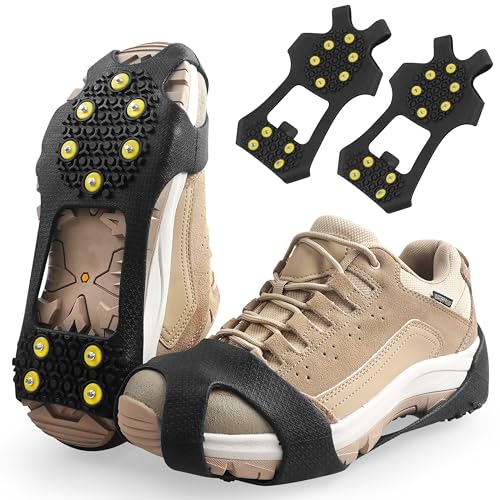
AGOOL Ice Cleats Snow Traction Crampons Slip-on Overshoe
The Details Behind The Selections
The MICROspikes are the option I’d reach for first on a real mountain day, not a neighborhood sidewalk. They’re built around a stretchy harness that pulls over a hiking shoe or light winter boot, and the bite comes from twelve heat-treated stainless steel points per foot: eight clustered under the ball of the foot, four tucked under the heel.
On icy switchbacks and packed-down snow, the front-heavy spike pattern is what gives the grip its confidence, since most of your weight lands on the forefoot while climbing. Compared to the rubber overshoe picks later in this list, the MICROspikes trade cushioning for a much more planted, aggressive feel on hard terrain. Treat them as trail hardware, and you’ll be happy.
What Helps Most
- Twelve stainless steel spikes per foot hold up well to repeated abuse on rocky winter trails.
- The eight-spike forefoot cluster digs into ice right where you push off, which matters on climbs.
- Stainless steel resists corrosion from road salt, slush, and trail grit.
- Compact enough to stash in a pack pocket on the way up and pull on before the icy descent.
- Sized for actual hiking shoes and boots rather than sneakers, so the fit feels secure.
Things To Consider
- Not designed for casual errands, since the hard spikes can scratch store floors and car interiors.
- Owners commonly report the elastomer harness stiffening in sub-zero cold, so warming them up indoors helps with fit.
Who It Suits Best
Backcountry hikers, ice climbers, and trail runners who need real bite on frozen terrain and understand the limits of the spike pattern.
Where Another Pick Suits Better
For someone just walking a dog on a snowy sidewalk, the AGOOL stretch-rubber picks later in this roundup make more sense, since they feel friendlier on pavement.
Most adult crampons simply don’t fit kids, and that’s the gap Giggleway tries to close. The harness is scaled down for smaller feet, with stainless steel points that mirror the bite pattern of grown-up versions. Parents walking the school path or pulling a sled up a hill finally get a real traction option instead of crossing their fingers on the ice.
Where the Kahtoola MICROspikes lean toward trail performance, this pick leans toward everyday school-day and weekend-walk practicality. The trade-off shows up in sizing, because kids grow fast, so I’d check the current size chart before committing. For active families who already invest in proper kids winter boots, this is a sensible companion.
Where It Helps
- Scaled-down harness fits smaller boots and hiking shoes without bunching.
- Stainless steel spikes handle slush and grit without quick rusting.
- Reasonable for school commutes, frozen playgrounds, and short trail walks.
Minor Gripes
- Spike count and density sit below the adult Kahtoola MICROspikes, so they’re less aggressive on steep ice.
- Storage gets fiddly when kids outgrow a size mid-season; households often rotate through pairs.
- Parents commonly mention that kids need a minute to learn the right pull-on motion.
Made For
Parents of active kids who walk, hike, or play on snow-packed and icy surfaces and want traction scaled for small boots.
Consider Something Else When
Adults on real mountain terrain get a more confident feel from the Kahtoola MICROspikes, since the spike layout is purpose-built for hiking loads.
This one reads more like work gear than weekend gear. The Spare Spike is built around tungsten carbide points that resist wear far longer than standard steel, which is exactly what you want when you’re logging hours on icy pavement, a loading dock, or a snowy job site. A low-temperature elastic harness keeps the whole thing stretchy when the cold tries to stiffen the rubber.
Unlike the AGOOL rubber overshoes, which rely on dozens of small metal studs, this design uses fewer but tougher replaceable studs. The honest read is that for someone who pounds pavement every winter, the replaceable stud design is the smarter long-term play, since worn studs can be swapped rather than the whole traction.
Useful Touches
- Tungsten carbide studs outlast standard steel on gritty, salted surfaces.
- Replaceable studs extend the useful life of the pair instead of forcing a full replacement.
- Low-temperature elastic harness stays flexible in bitter cold.
- Trim line on the heel lets you customize the fit across the size range from XS to XXL.
Trade Offs
- Fewer contact points than the studded AGOOL picks, so bite on glare ice is less dense.
- Industrial styling isn’t subtle; some commuters prefer a lower-profile overshoe.
Best Suited To
Walking-intensive workers, mail carriers, and serious winter commuters who wear through cheap traction every year and value replaceable parts.
Skip It When
For lighter neighborhood use, the AGOOL Ice Cleats Snow Walk Traction Crampon 28 Studs offer more contact points at a more casual price.
The upgraded AGOOL overshoe leans into coverage. Twenty-eight metal studs wrap the sole, and a hook-and-loop strap across the top keeps the whole piece locked down on the boot, especially helpful for people with narrower feet who find pure stretch overshoes too floppy. The thermoplastic elastomer rubber, often shortened to TPE, stays flexible well below freezing.
Compared to the AGOOL budget pick later on, this version feels like a step up in security rather than a step up in material quality. For the dog-walk, school-drop-off, mailbox-check crowd, the strap is the small detail that makes daily use feel less fiddly. It’s a thoughtful upgrade without overcomplicating things.
Features That Help
- Twenty-eight studs distribute bite across the entire sole, helping on patchy ice and snow.
- Top strap keeps the overshoe stable on slimmer boots where stretch-only designs slip.
- TPE rubber handles frigid temperatures without going brittle.
Points To Keep In Mind
- More parts to handle when pulling on and off in a rush by the door.
- Studs are standard steel rather than tungsten, so heavy grit wear shortens life versus the Winter Walking pick.
Perfect Match For
Daily commuters and dog walkers with narrow feet who want a strap-secured overshoe for mixed snowy and icy sidewalks.
Look Elsewhere When
Backcountry hikers get better traction bite from the Kahtoola MICROspikes, since aggressive trail terrain favors dedicated spike layouts.
The plain AGOOL slip-on is the no-fuss option in this roundup. No straps, no buckles, just a stretchy TPE rubber overshoe with hook-and-loop tabs at the toe and heel for a quick fit adjustment. Slip them on at the door, slip them off when you hit the mat, and you’re moving.
Where the strap-equipped AGOOL 28-stud version offers more security, this one trades that for speed and a lower cost. It’s the pick I’d grab for a backup pair that lives in the trunk all winter, or for anyone whose main winter surface is a paved driveway and a few sidewalk squares.
Standout Benefits
- Quick pull-on design suits cold fingers and rush-out-the-door mornings.
- TPE rubber holds flexibility in freezing temps without cracking early.
- Lower cost than strap-equipped or spike-equipped options, useful as a backup pair.
Honest Caveats
- Without a top strap, the fit shifts more on narrow boots during long walks.
- Stud layout is less dense than the 28-stud AGOOL, so traction on pure black ice is less aggressive.
Who Should Grab It
Casual winter errand-runners who want a basic, easy-on traction overshoe for short, paved outings.
Reach For A Different Pick When
Anyone walking miles a day in harsh conditions should step up to the AGOOL Ice Cleats Snow Walk Traction Crampon 28 Studs for the strap security.
The last AGOOL on the list is the one I’d hand to a household that doesn’t want to think too hard about sizing. It runs from small to double extra-large, with men’s and women’s size ranges printed right on the packaging concept, so a family with mixed-size feet can outfit everyone from a size-five sister to a size-fifteen uncle without juggling listings.
Where the budget AGOOL earlier keeps things minimal, this version focuses on fitting more boots well. The TPE body stretches over everything from light hikers to pac boots, and the pull-on tabs at heel and toe make removal less of a wrestling match. It’s the easygoing everyday pick in the AGOOL family.
A Few Strong Suits
- Wide size spread fits both slim women’s boots and larger men’s work styles in one listing.
- TPE rubber stretches over bulky pac boots without bunching at the ankle.
- Easy on and off for users with limited hand strength in cold weather.
- Reasonable for a spare pair kept in a coat closet or car trunk.
Points To Note
- Studs aren’t tungsten carbide, so heavy grit wear shortens life on untreated roads.
- Without a top strap, very narrow boots may need extra adjustment.
The Right Fit
Multi-user households and gift-givers who want one traction listing that covers most adult boot sizes without picking the wrong size.
Another Choice May Suit
Workers who need long-term stud durability should look at the Winter Walking Spare Spike, since its tungsten carbide points are built for that grind.
Picking Traction Gear That Suits Your Winter Routine
A good starting question is where you actually walk most days, since trail ice, suburban sidewalks, and job-site pavement each reward a different design. Spike-style traction, like the Kahtoola MICROspikes, shines on hard, frozen ground where you need a focused bite. Stretch-rubber overshoe picks trade some bite for comfort on paved walks and quick on-and-off use.
Stud material matters more than most people expect. Standard steel studs grip well and cost less, but they wear down faster on gritty, salted surfaces. Tungsten carbide studs cost more up front, yet they hold their shape much longer under that kind of abuse, which is why they tend to appear on work-oriented traction.
Sizing and stretch deserve real attention, since a loose traction overshoe shifts underfoot and steals confidence. Pull-on rubber designs stretch over bulky boots but may slip on narrow feet, while strap-equipped designs add security at the cost of a few extra seconds by the door. A kids-specific harness, like the Giggleway pick, prevents the worst-fitting mistake: forcing an adult traction onto a small boot.
Things Worth Knowing Before You Commit
Where Shoppers Go Wrong
A common misstep is choosing a heavy-duty spike design for a casual paved walk, where the hard points scratch floors and feel clunky indoors. Another is grabbing the cheapest rubber overshoe without checking stud layout, since a sparse stud pattern feels fine on fresh snow but fails on glare ice.
The Upgrade Payoff
Paying more often means better stud materials, more secure fit hardware, or purpose-built sizing. The Winter Walking Spare Spike earns its higher tier through replaceable tungsten carbide studs. The Kahtoola MICROspikes earn theirs through a trail-focused spike layout and stainless steel durability. Both upgrades only pay off when the use case matches the engineering, so match the design to the surface before deciding the price is worth it.
Frequently Asked Questions
Do traction overshoes work on black ice?
They help a lot on black ice when the stud or spike pattern is dense and the metal is hard. Pure black ice remains tricky for any traction, so shorter steps and slower pace still matter.
Can I wear ice cleats on regular sneakers?
Most stretch-rubber designs fit over casual sneakers and lightweight boots. Spike-style options like the MICROspikes fit best on hiking shoes or winter boots with a structured sole.
How long do the studs usually last?
Standard steel studs handle a season of moderate use on paved walks. Tungsten carbide studs outlast steel under heavy use, especially on gritty or salted surfaces.
Are kids’ crampons safe on normal boots?
Yes, when sized properly and fitted over sturdy winter boots. A loose-fitting pair shifts under load, which is the main safety risk to watch for.
How should I store traction gear in summer?
A cool, dry spot out of direct sunlight keeps the rubber harness from breaking down between seasons. A simple bin in a closet works fine for most pairs.
Final Verdict
The right pick depends on where your feet actually go in winter. Hikers and ice climbers get the most from a serious spike design, while most everyday walkers benefit more from a stretch-rubber overshoe with enough studs and a secure fit. Match the design to your surface, check the sizing carefully, and your boots will earn their keep all season long.